Temperature Super Resolution
Highlights
Results
Details
Learning-based super resolution of thermal images to reconstruct high-resolution temperature fields from low-resolution sensor data.
Problem
Thermal imaging systems often trade spatial resolution for cost, frame rate, or hardware constraints.
As a result, low-resolution temperature maps lack the spatial detail required for accurate analysis, monitoring, or downstream decision-making.
The objective of this project was to reconstruct high-resolution temperature distributions from low-resolution thermal inputs, while preserving both global structure and localized temperature gradients.
Key challenges:
- Strong information loss in low-resolution inputs
- Smooth but spatially complex temperature fields
- Sensitivity to noise and illumination artifacts
- Need for physically plausible reconstructions, not just visually sharp outputs
Approach
Data
- Paired low-resolution and high-resolution thermal images
- Total samples: 9,864 image pairs
- Resolutions:
- Low-res: 120 × 160 (reshaped from 122 × 160)
- High-res: 480 × 640
- Train / validation / test split: 80% / 10% / 10%
- Augmentation applied only to training data:
- Flip, rotation, shift, scale
- Elastic deformation
- Brightness, contrast, gamma
- Hue saturation and noise
Model
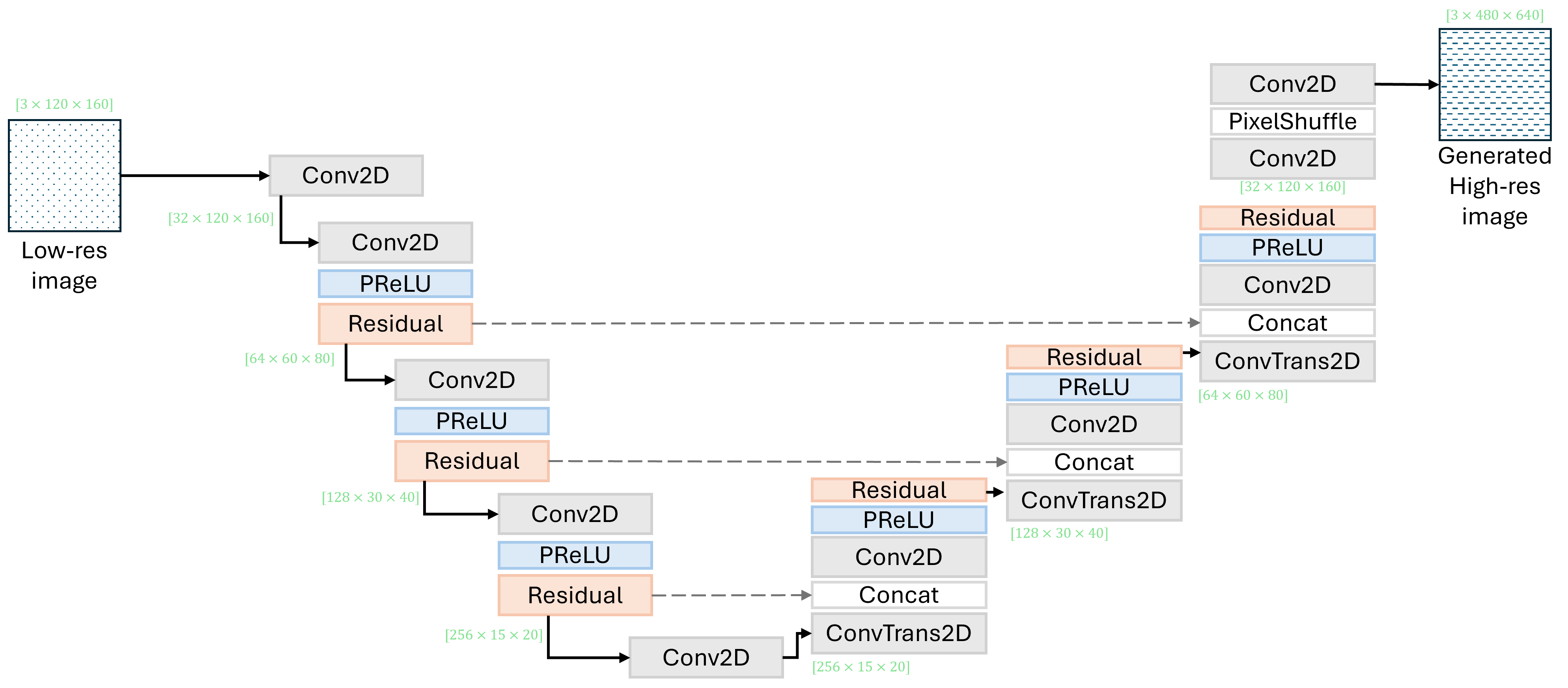
- Residual U-Net inspired by SRResUNet
- Encoder–decoder structure with:
- Residual blocks and PReLU activations
- Multi-scale feature aggregation via skip connections
- Upsampling performed using PixelShuffle, avoiding checkerboard artifacts common in transposed convolutions
- Final output reconstructs full-resolution temperature maps
Training
- Loss function: L2 reconstruction loss
- Optimizer: Adam
- Learning rate: 1e-4
- Batch size: 32
- Training duration: 100 epochs
- Experiment tracking using Weights & Biases
Evaluation
- Reconstruction loss evaluated on validation and test splits
- Final losses:
- Training: 0.0114
- Validation: 0.0146
- Test: 0.0139
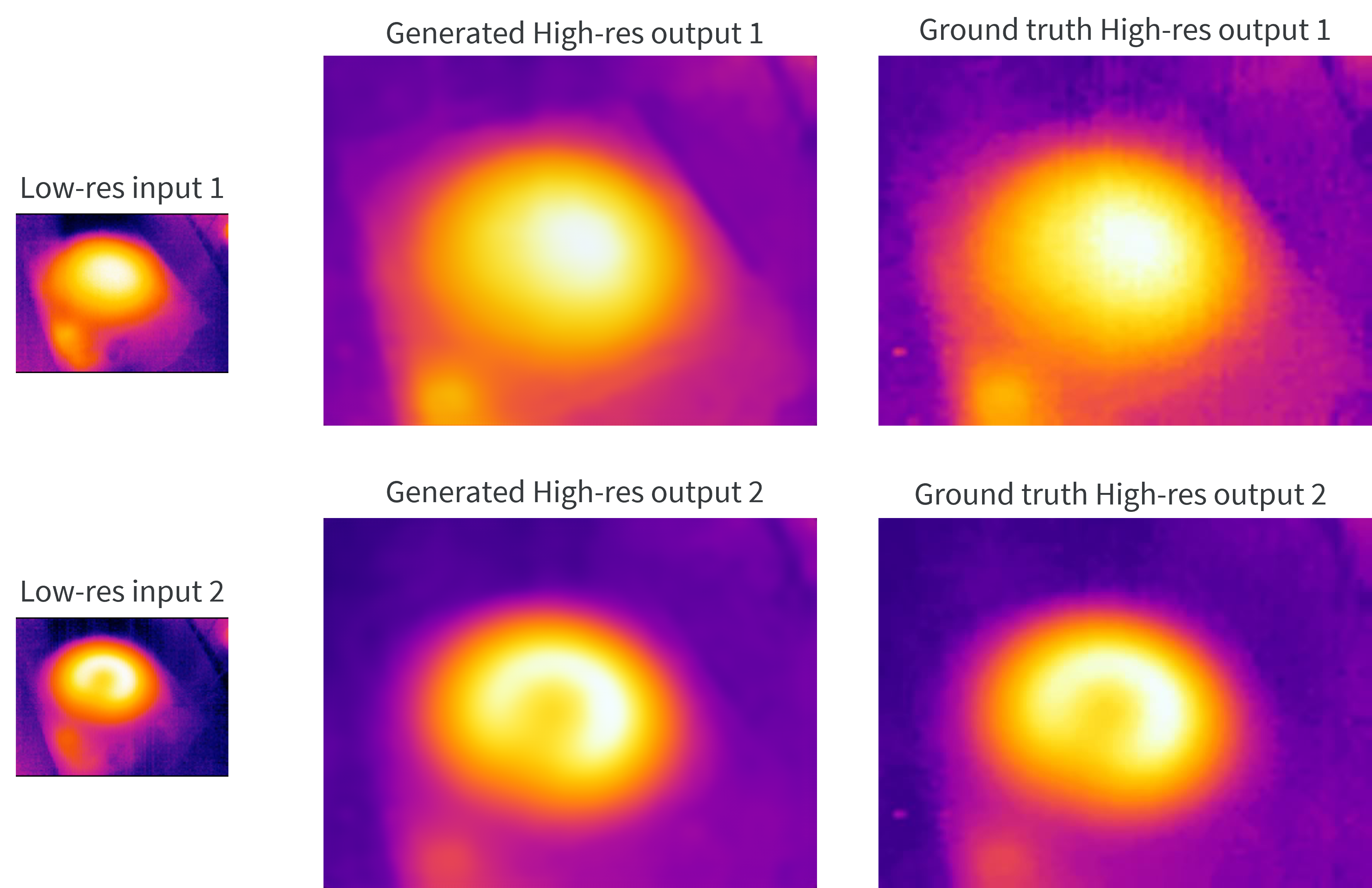
- Qualitative evaluation focused on:
- Preservation of temperature gradients
- Structural consistency with ground truth
- Absence of hallucinated artifacts
Notes & Lessons Learned
- Residual connections are critical for stable convergence in thermal super resolution
- PixelShuffle upsampling produced smoother and more physically plausible outputs than naïve transposed convolutions
- L2 loss was sufficient due to the smooth nature of temperature fields; perceptual losses were unnecessary
- Data augmentation significantly improved generalization, especially under limited sensor variability
- Visual realism must be evaluated alongside numerical loss for safety-critical thermal applications
This project reinforced the importance of architecture choice and data quality when applying super-resolution techniques to physically grounded imaging modalities.