ClimaX via Radar
Highlights

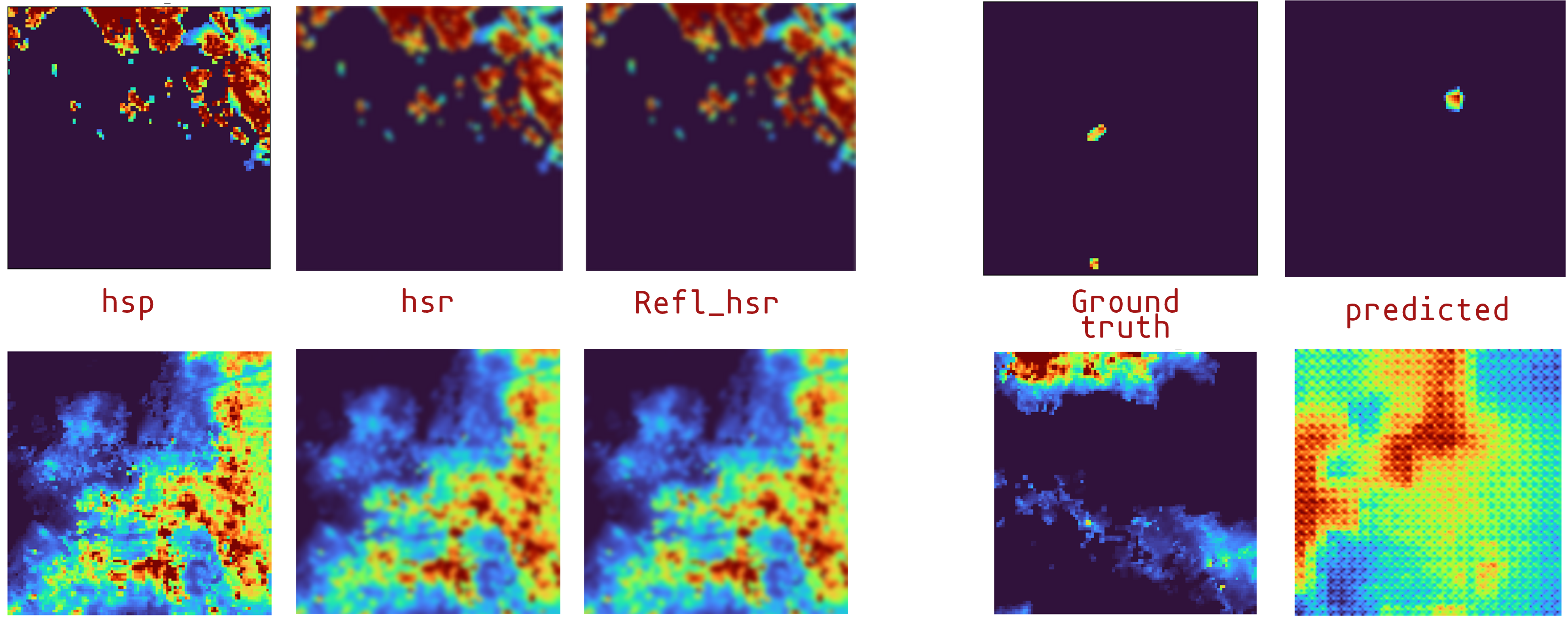
Results
Details
Regional radar-based rainfall forecasting using the ClimaX transformer with multi-variable radar inputs.
Problem
Accurate rainfall forecasting from radar data requires modeling highly non-linear spatiotemporal dynamics across multiple atmospheric variables.
Conventional numerical and heuristic methods struggle to jointly capture local convective structures and large-scale weather patterns, especially for longer forecast horizons.
This project investigates whether ClimaX, a transformer-based climate model, can be adapted for regional radar-based rainfall prediction.
Approach
Data
We used Korean radar composite data with the following characteristics:
- Temporal resolution: 10-minute intervals
- Spatial resolution: 100 m
- Original grid size: 2305 × 2881
- Projection: Lambert Conformal Conic (LCC)
- Target region: Seoul metropolitan area
Radar variables:
- HSP: Radar-estimated rainfall intensity (mm/hr)
- HSR: Rainfall derived from radar reflectivity
- HSR_dBZ: Raw radar reflectivity (dBZ)
Data preprocessing steps:
- Values ≤ −20000 treated as missing
- Rainfall values scaled by dividing by 100
- Reflectivity converted using the Marshall–Palmer Z–R relationship
- Spatial cropping and downsampling to 100 × 100 grids
- Dataset-wide normalization
- Construction of a climatology map for ClimaX conditioning
Days with missing radar channels were excluded.
Model
We adopted RegionalClimaX, a grid-to-grid transformer model originally designed for climate variables.
Model configuration:
- Patch size: 4 × 4
- Embedding dimension: 1024
- Transformer layers: 8
- Attention heads: 16
- Positional embeddings enabled
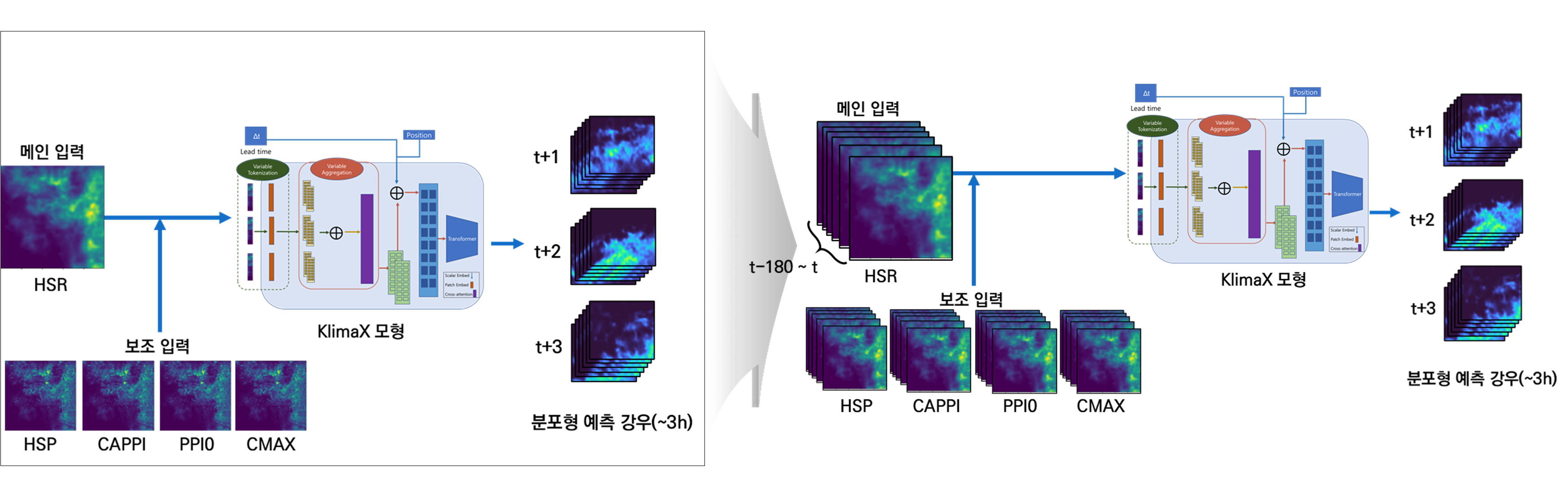
Each radar variable is tokenized independently and aggregated via cross-variable attention, allowing the model to learn dependencies between reflectivity and rainfall intensity.
Training
- Total samples: 188,071
- Time span: June 2021 – December 2023
- Train / validation / test split: 70% / 20% / 10%
- Batch size: 32
- Epochs: 10
- Forecast horizon: up to 72 hours
- Training from scratch on a single GPU
- Runtime: approximately 40 minutes per epoch
Multiple configurations were explored, including single-variable and multi-variable inputs.
Evaluation
Performance was evaluated using:
- Test accuracy
- Mean squared error
- Qualitative inspection of spatial rainfall patterns
Key observations:
- Multi-variable inputs improved accuracy over single-variable baselines
- Large-scale rainfall structures were captured reliably
- Fine-grained convective details were often smoothed
- Patch-wise artifacts appeared in longer-horizon forecasts
Notes and Lessons Learned
- ClimaX effectively models structured, multi-variable geophysical data
- Multi-variable conditioning is critical for radar-based forecasting
- Patch tokenization limits fine-scale detail in long-horizon predictions
- Future improvements may include:
- Multi-scale patching
- Temporal attention refinement
- Hybrid convolution–transformer front-ends
This project served as a foundation for further exploration of transformer-based weather and climate forecasting using radar observations.